※ Based on a real Forecast AI case. Personal details such as the names of the people in the chat have been changed to keep it unidentifiable. (The AI persona names that appear are fictional characters.)
In one line
After uploading the entire chat export of a couple's argument as a file, 4 AI personas analyzed the story across two meetings — and ultimately delivered a fault-ratio verdict (70 : 30).
1. Situation
- File: A couple's chat export file (the story of the argument), uploaded as-is
- The gist: Man A was drained by burnout (3 weeks of too little rest) and grew distant about contact and meeting up; Woman B, wanting "to feel loved, not just know it in her head," had built up enough hurt to boil over
- How it ran: One story across two meetings — ① a panel debates causes and fixes, then ② a judge rules on a fault ratio
2. Personas (4)
| Persona | Personality |
|---|---|
| Big Sis Sully | A been-there-done-that life mentor. Reads the story with intuition and empathy |
| The Analyst | Loves psychology and relationship patterns. Analyzes with data and theory |
| The Love Justice | A judge specializing in personal-relationship disputes. Handles it with an objective ruling |
| Magistrate Yeonsim | A magistrate of a Joseon-era courthouse. An old-style judge who settles things with thundering rebukes |
The key is handing the same chat to personas with very different grains — empathetic ↔ analytical, modern judge ↔ Joseon magistrate. Different viewpoints see different things in the same file.
3. Meeting 1 — who was more in the wrong (panel debate)
Big Sis Sully (empathy) and The Analyst (analysis) trade first impressions, causes, and fixes.
| Speaker | Gist |
|---|---|
| Big Sis Sully | "You can tell A is just worn out. When one side is overwhelmed, there's no room left to read the other's feelings. And that's piled up in B to the point of bursting." |
| The Analyst | "A is showing an avoidant defense mechanism from burnout; B is in an anxious pattern from unmet emotional needs. A textbook case of 'attribution error' and 'mismatched expectations.'" |
| Big Sis Sully | "In the end the biggest fix is whether A can show his state not just 'honestly' but 'vulnerably.' The courage to show weakness." |
| The Analyst | "Exactly. Exposing vulnerability is a powerful signal for restoring trust and intimacy. In return, B has to receive it as honesty, not weakness." |
Meeting-notes conclusion
- Core of the fight: burnout (a situational factor) + mismatched expectations + clashing communication styles + attribution error
- Fixes: ① A's vulnerability disclosure (confessing his concrete state) ② B's expectation reset + accepting small touchpoints (short meetups, calls, messages) ③ communication rules for both (specificity, receptiveness)
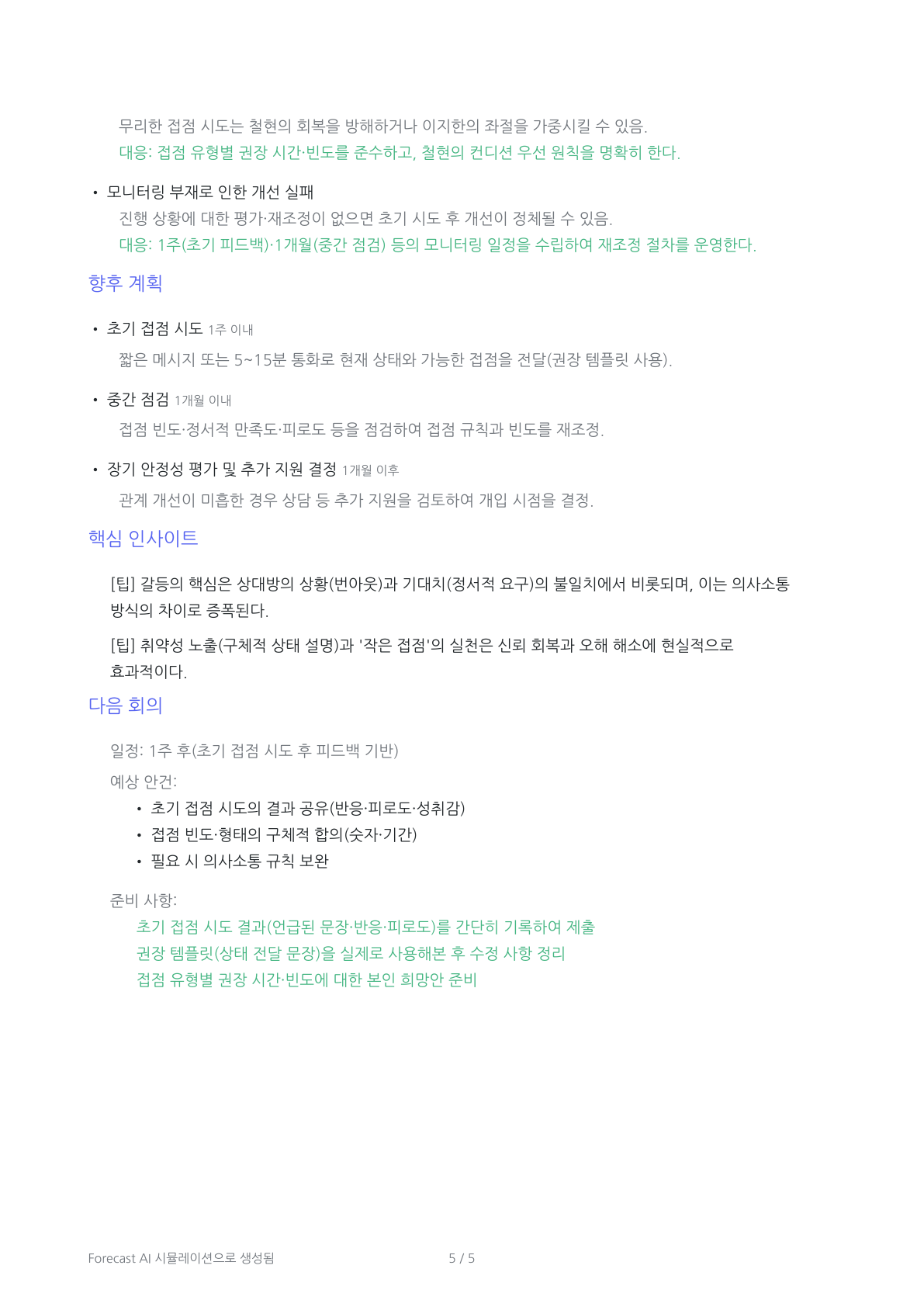 The next-steps and key-insights part of the first meeting's notes.
4. Meeting 2 — The Love Justice's ruling (fault ratio)
Taking Meeting 1's results as input, The Love Justice and Magistrate Yeonsim square off over the fault ratio.
| Speaker | Argument |
|---|---|
| Magistrate Yeonsim | "Both man and woman bear fault. Yet the man's avoidance sprang in part from the woman's ceaseless prodding — six to four (60:40) is fitting." |
| The Love Justice | "In the chat, B offered concrete alternatives — 'just see each other a moment, share a meal… you could've come over and just laid down' — while A kept to 'I didn't think of it.' Avoidance is the main cause — 70 : 30." |
Final verdict: Man A 70% : Woman B 30%
- Adopted: The Love Justice's view (70:30). Magistrate Yeonsim's dissent (60:40) is recorded as a minority opinion
- Criteria: whether concrete alternatives were offered · attitude in response · consistency of communication
- Decisive grounds: B's concrete proposals vs A's dismissive "I didn't think of it"
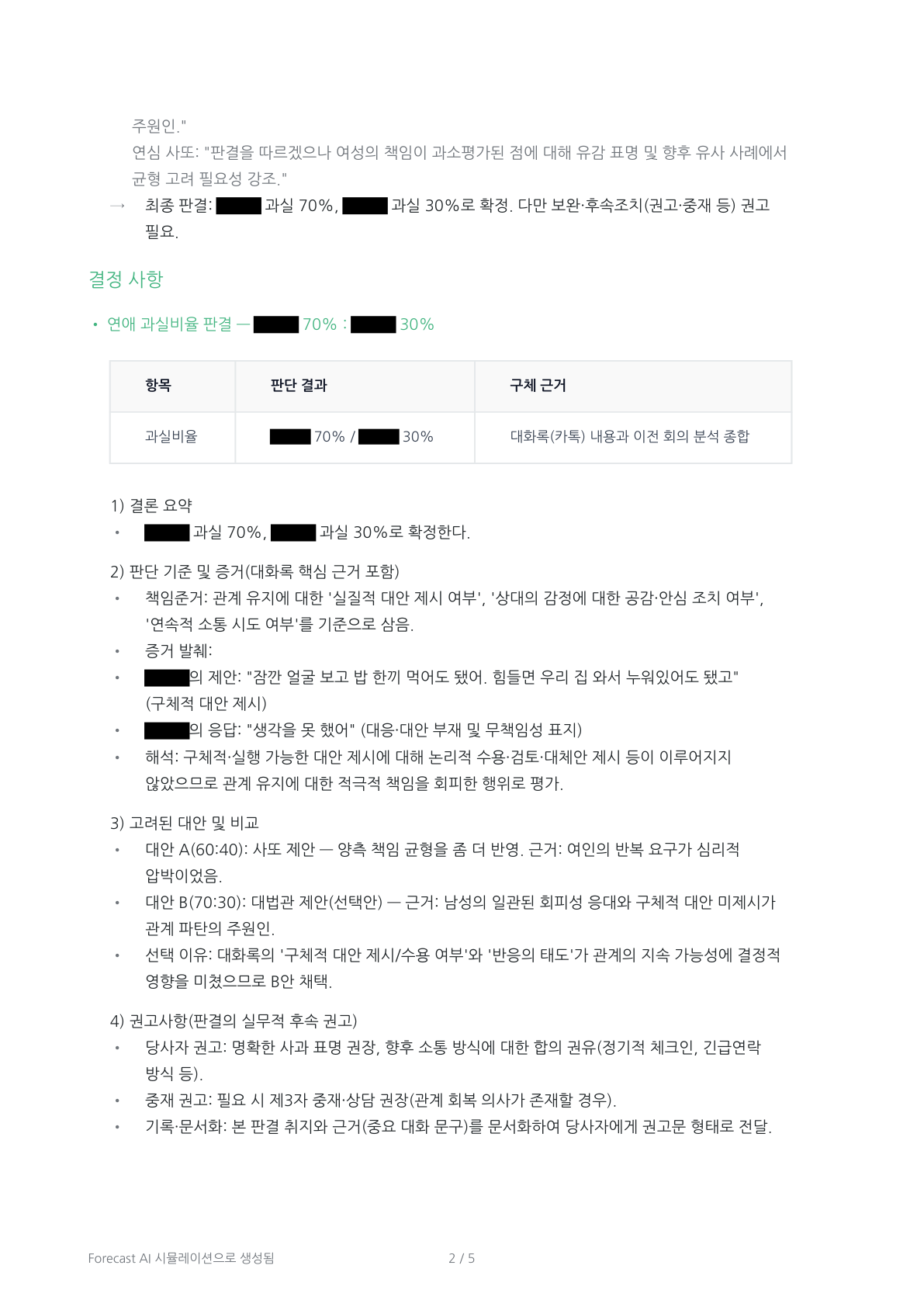 The fault-ratio verdict (70:30) part of the second meeting's notes. Names are redacted.
5. Takeaways
- Same file, many viewpoints. Putting an empathetic type (Big Sis Sully) and an analytical type (The Analyst) together makes one story look three-dimensional. It corrects the one-sided judgment you'd easily fall into alone.
- Chain meetings together. Hand the first debate's result to a second meeting and it deepens in stages, like "analysis → ruling."
- Real conversation data, as-is. Upload a chat export and the AI judges from actual lines ("I didn't think of it") rather than vague advice. See Files for how to upload files.
- Fun and useful at once. Crowd-pleasers like the magistrate's rebukes and a fault-ratio verdict come out alongside fixes you can actually use.
Try it yourself
In Quick Start, upload a chat export and write something like "analyze who was more in the wrong in this fight, and rule on it with a fault ratio" to run it similarly. Characters like judges and panelists can be built in Personas.
