※ Based on a real Forecast AI case. Personal details and some specifics have been changed to keep it unidentifiable.
In one line
The moment a finger hovered over the "Pay" button, the "me who wants it" was made to face a "Spending Reaper" persona. The verdict wasn't "don't buy it" — it was hold for three days (72 hours), then look again.
1. Situation
- Agenda: Whether to buy a ~$100 hobby collectible (a figure). It's a favorite series the buyer collects every year.
- Goal: To check whether "this thing I want to buy now" is a choice the me-of-a-year-from-now won't regret.
- Not just "buy or don't" — the plan was to get a verdict of one of three: buy now / don't buy / hold three days.
- Prep: Before starting, a year of personal finances (a budget ledger) was uploaded as a file and taught to both My Persona and the Spending Reaper. That let the Reaper argue from actual spending patterns and hours-of-work conversions instead of vague nagging.
2. Personas
| Persona | Role |
|---|---|
| Buyer A | A salaried worker in their 30s with steady income and some savings. Holds that "it's a planned hobby, so no regrets" |
| Spending Reaper | A persona that appears the instant a finger hovers over "Pay" just before an impulse buy. Relentlessly presses on hours-of-work conversions · cumulative cost · spending habits |
Buyer A is the actual user, and the Spending Reaper is a persona the user built. In other words, they created an opponent to judge their own impulse strictly, and went one-on-one with it.
3. The simulation (excerpt)
At first Buyer A defended with reasonable grounds (the hobby, their finances), but the tone shifts as the Reaper presses with "this money equals how many hours of your labor" and "buy it every year and what's it worth in 10 years."
| Speaker | Content |
|---|---|
| Spending Reaper | "Converted into your working hours, that money is never light. You say it's a hobby you collect yearly — but ask yourself if it'll still thrill you a year from now. Hold for three days." |
| Buyer A | "It's my favorite series, so I won't regret it. This isn't reckless spending — it's part of a planned hobby." |
| Spending Reaper | "The line between 'planned hobby' and 'reckless spending' is faint. Of all the things you've bought online, how many still thrill you the way they did at first?" |
| Buyer A | "…Looking back, almost nothing still thrills me like it did. Most of it ends in a brief satisfaction and then drops off my radar — that's the reality. My biggest worry is that this figure goes the same way." |
In the end Buyer A themselves admits "I'd probably regret it again," and the urge cools off.
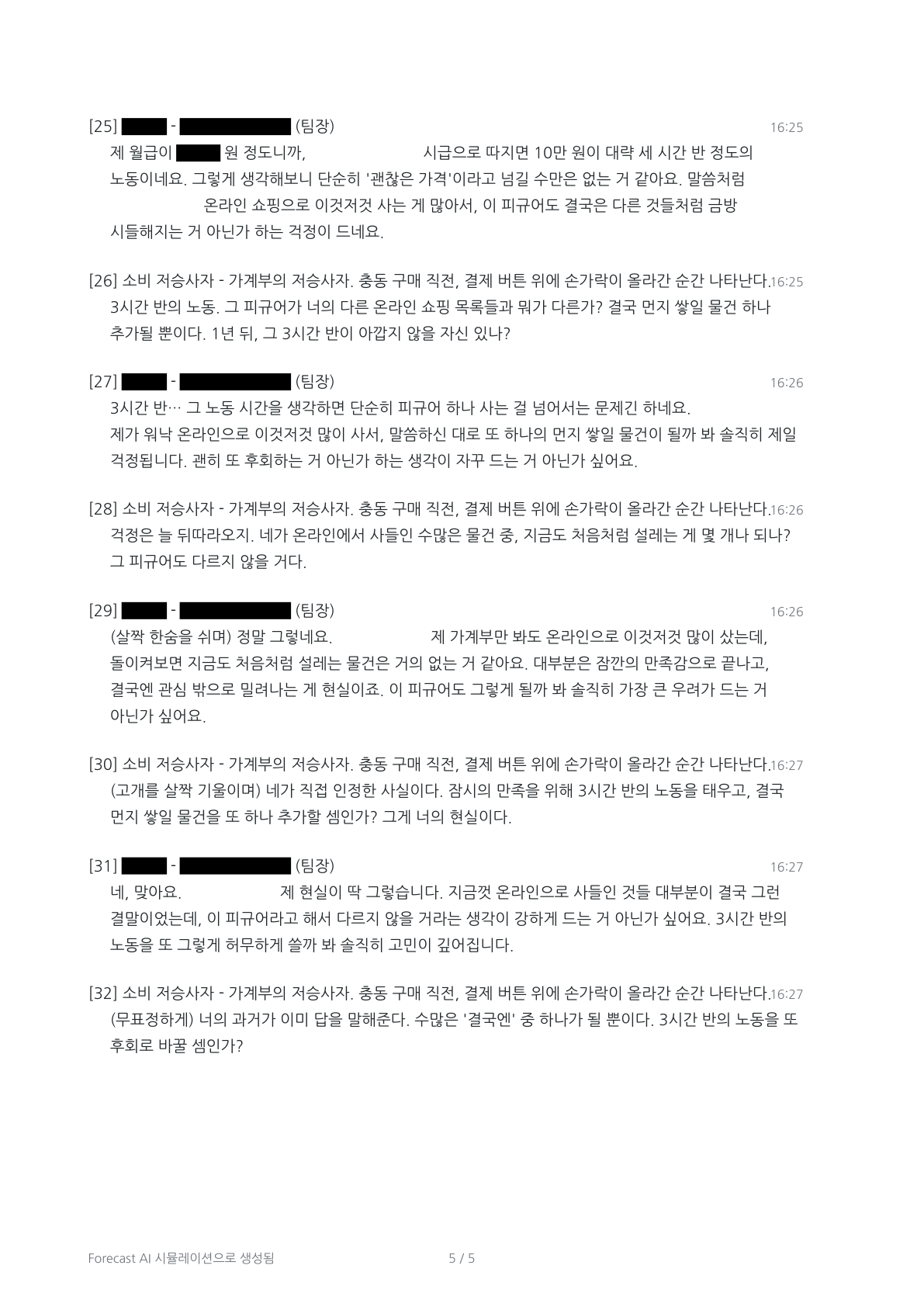 The closing lines of the real transcript (personal details redacted). The buyer admits, on their own, that "almost nothing still thrills me like it did at first."
4. The result — the verdict in the meeting notes
The meeting notes built after the simulation summed it up like this.
Final verdict: hold for three days (a 72-hour wait)
No buying now. Wait at least 3 days; if the resolve is unchanged after the wait and it passes the checklist below, buy it then.
3-day reassessment checklist
| Item | Criterion |
|---|---|
| Lasting feeling | Pass if the urge is the same or stronger after 3 days. If interest noticeably cools, treat it as an unnecessary purchase |
| Financial check | The purchase's share of monthly income · keeping the emergency fund · whether it worsens debt |
| Cumulative cost | Knowing "keep this hobby up yearly and it's $X in N years" — and whether that's acceptable |
| Behavior control | Hold off if recent spending shows impulsive or repeated outlays |
Key insights
- Even a small amount feels different once it's converted into working hours.
- A purchase decision causes less regret when you check not only finances but also how long the feeling lasts.
- A 72-hour wait is a simple, effective device that cools the impulse and makes a rational reassessment possible.
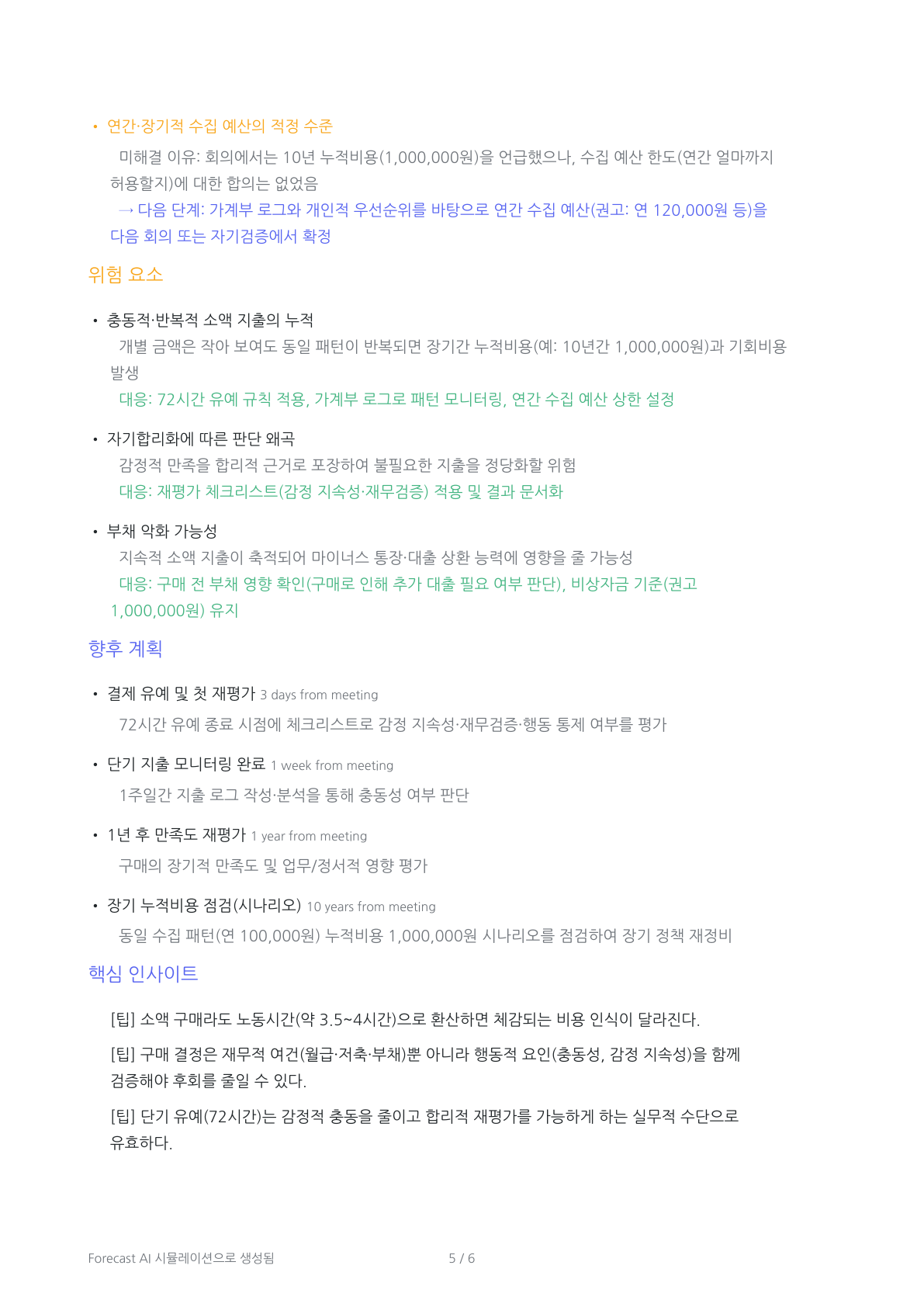 The risk-factors, next-steps, and key-insights part of the real meeting notes.
5. Takeaways
- Teach the personas your real data first and they argue from your situation, not generalities. Here, teaching it a year of finances (a budget ledger) is what let it dig in with specifics like "that money is how many hours of your labor." See Files for how to share files with a persona.
- Reframing an impulse buy from "buy / don't buy" to "wait and look again" lets you reach a better decision without the guilt.
- Ten minutes before checkout is enough. Build a persona that scrutinizes your impulse strictly (here, a "Spending Reaper") and go head-to-head — and the excuses and real feelings you couldn't put into words come out.
- Keep the result as meeting notes and a checklist, and you can pull it right back out the next time a similar urge hits.
Try it yourself
In Quick Start, just describe the situation — e.g. "I'm thinking of buying ○○ right now. Give me a strict opponent like a 'Spending Reaper' to judge my impulse" — and a similar simulation is built. See Personas for how to create personas.
